
Build a More Connected Intelligence Graph
Add structured intelligence extracted from reports into existing TIPs, CTI platforms, graph stores, and internal data environments.
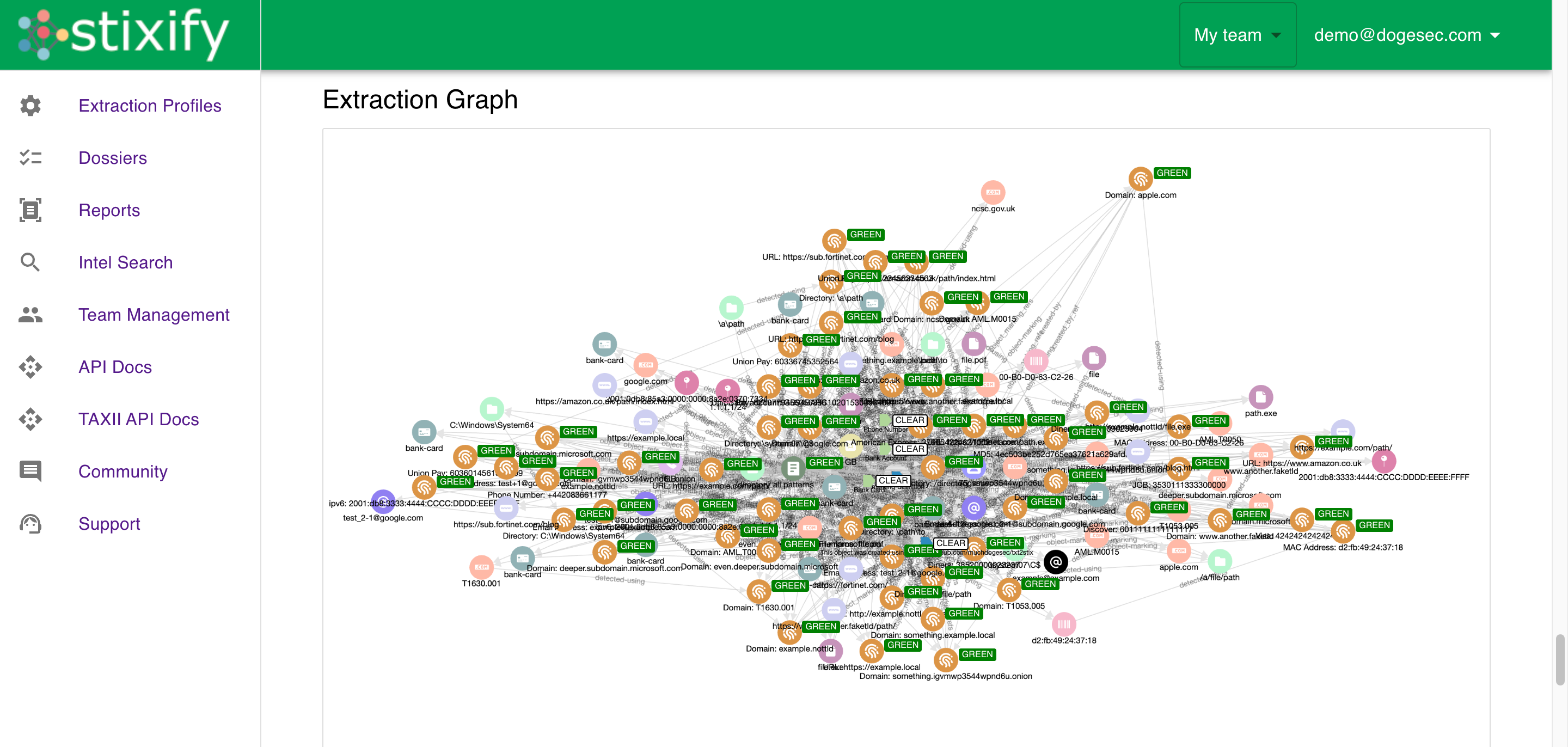
Overview
Many teams already have a place where intelligence comes together: a TIP, a graph, an OpenCTI deployment, or an internal datastore. The challenge is getting intelligence out of reports and into that environment in a structured, reusable form.
Stixify helps solve that upstream problem. It converts unstructured source material into structured STIX 2.1 intelligence that can feed the systems teams already rely on for correlation, knowledge management, and downstream analysis.
This is an important distinction. Stixify is not trying to replace an existing CTI platform or graph layer. Its role is to make source reporting easier to contribute to one.
What this outcome looks like
Building a more connected intelligence graph means:
- turning report content into linked objects and relationships
- making external reporting easier to combine with internal intelligence
- adding ATT&CK, observable, and report context to existing graph workflows
- preserving a standards-based structure for downstream reuse
- improving search and pivots across multiple intelligence sources
The key outcome is that report-derived intelligence becomes easier to connect to what the organisation already knows.
Why this matters
An intelligence graph is only as useful as the quality and structure of the data entering it.
When external reporting stays trapped in PDFs and documents, it is harder to correlate with sightings, cases, detections, and other internal context. Structured extraction makes that external intelligence portable.
That portability matters because graph value often comes from relationships:
- how one observable connects to another
- how behaviour links to a campaign or family
- how multiple reports reinforce the same pattern
- how external intelligence supports internal findings
If those relationships never leave the source report, the wider graph stays weaker than it could be.
Move from isolated reports to linked objects
Most intelligence environments are built to reason over objects and relationships, not over long-form documents alone.
Stixify helps by producing structured outputs that are easier to insert into that model. Instead of only keeping the source report as a narrative reference, teams can work with extracted IoCs, techniques, related entities, and connected context in a form that downstream systems understand more naturally.
That supports workflows such as:
- enriching a TIP with report-derived observables
- expanding an internal graph with behaviour and relationship data
- connecting external report content to internal detections or investigations
- improving graph search with more structured context from trusted reporting
Strengthen existing CTI platforms
For teams already using platforms such as OpenCTI, internal graph stores, or other intelligence repositories, the challenge is rarely whether those systems can store structured intelligence. The challenge is often getting more good structured intelligence into them.
Stixify helps upstream of that problem by converting otherwise unstructured reporting into something those systems can consume more effectively.
That means the wider graph can benefit from:
- more external observables
- more ATT&CK-aligned behaviour context
- more linked report references
- more reusable STIX-native data for correlation and search
Where Stixify fits
Stixify fits before the graph, not instead of it.
Its role is to take unstructured source material and produce structured intelligence that can then be moved into a wider CTI environment through exports, APIs, and standards-based sharing.
That positioning matters because it keeps the product description accurate. The graph, TIP, or CTI platform remains the destination environment. Stixify improves what enters it.