
Reduce Manual CTI Extraction and Enrichment
Help analysts spend less time copying data out of reports and more time using structured intelligence for enrichment, correlation, and investigation.
Overview
Manual CTI work is often dominated by repetitive extraction and cross-referencing. Analysts read a report, copy out indicators, note down techniques, check for related reporting, and then repeat the process again for the next document.
That pattern slows teams down in ways that are easy to underestimate. Even when every step is manageable on its own, the repeated overhead adds up across every investigation, every monitoring cycle, and every report that needs to become usable intelligence.
Stixify helps reduce that manual burden by extracting structured threat intelligence directly from unstructured content and making the result easier to search, pivot, and reuse.
What this outcome looks like
Reducing manual CTI extraction and enrichment means:
- spending less time parsing reports by hand
- making IoCs and TTPs available faster for follow-on workflows
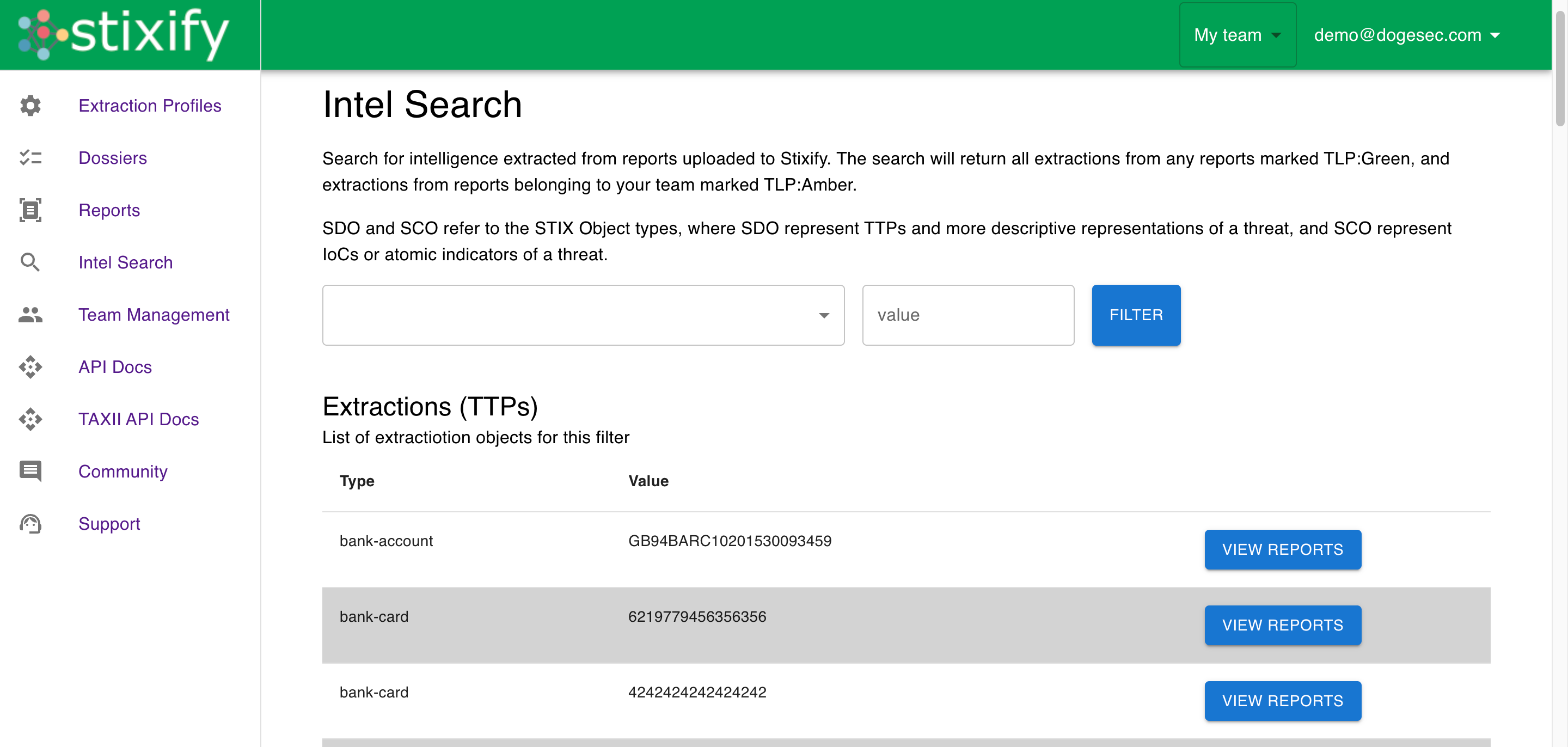
- using structured pivots to find related reporting and entities
- keeping report context attached to extracted intelligence
- making enrichment more repeatable across analysts and teams
The outcome is not only faster processing. It is a more reliable starting point for later analysis.
Why this matters
The more time analysts spend on repetitive extraction work, the less time they have for interpretation, prioritisation, and decision support.
Structured extraction does not replace analysis. It helps analysts start from a cleaner foundation so they can move more quickly into the work that actually requires judgement.
This matters especially when teams are working across many reports at once, or when external reporting must be used quickly enough to support ongoing hunts, triage, or customer-facing intelligence work.
Move from copy-and-paste to reusable intelligence
A large amount of CTI overhead comes from converting content into something usable.
That often includes:
- pulling indicators out of long-form text
- identifying techniques mentioned in prose
- preserving the relationship between objects and the original report
- checking whether the same detail appears elsewhere
- carrying the resulting context into another tool or workflow
Stixify compresses much of that process by producing structured outputs earlier. Once intelligence is extracted in a reusable form, analysts can spend less time recreating the same context and more time building on it.
Make enrichment easier to repeat
One of the strongest benefits of structure is repeatability.
When one analyst enriches an observable or technique manually, the value often stays with that analyst unless it is rewritten somewhere else. When enrichment starts from structured objects linked to the originating report, the result is easier to search, revisit, and extend later.
That helps teams:
- return to previous work more quickly
- compare related reports without rebuilding basic context
- share a more consistent view across analysts
- avoid duplicated manual effort on recurring entities or behaviours
Repeatability is especially important for teams handling high volumes of similar reporting or recurring research themes.
Where Stixify fits
Stixify is a strong fit for teams that already receive high volumes of external reporting and want a better way to turn that material into usable CTI.
It supports workflows where the goal is not only to read a report, but to:
- extract its useful intelligence
- enrich that intelligence with related context
- reuse it in later analysis
- move it into the systems where the team already works
That means it helps not just at the first point of extraction, but across the broader lifecycle of enrichment and reuse.
Why this is a solution, not just a convenience
Reducing manual work is easy to describe as a productivity benefit, but the effect is broader than that.
Less manual extraction usually leads to:
- faster access to usable intelligence
- more consistent handling of similar reports
- fewer lost relationships between objects and source context
- easier downstream integration and graph expansion
That makes the solution strategically useful, not merely easier to operate day to day.